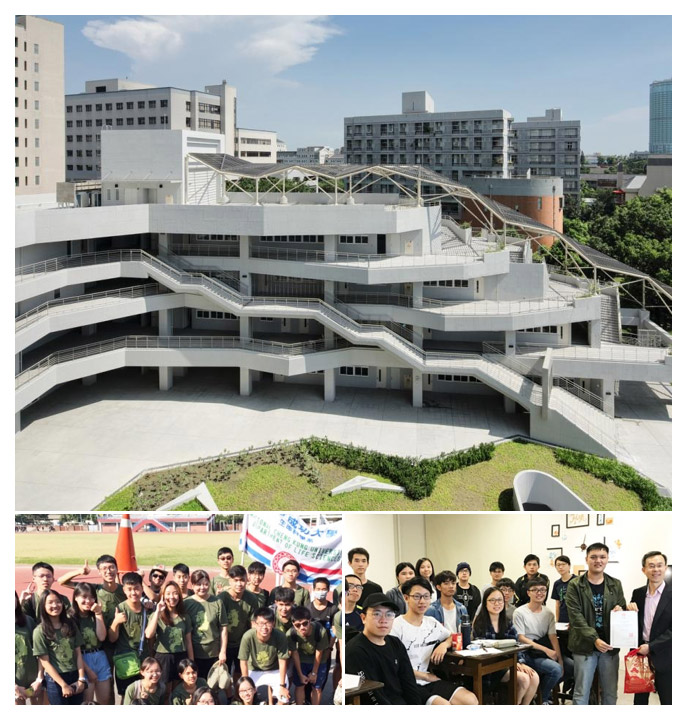
Our university was approved in 1981 (ROC year 70) to establish the College of Medicine. During the preparation process, former President Hsia Han-Min followed the United States, the most advanced country in medicine at the time, as a model and planned the Post-baccalaureate Medical Program as a cradle for cultivating physician-scientists at National Cheng Kung University. It was understood that the foremost task was to establish a department dedicated to training undergraduate students in biomedical sciences. Initially, the department was named the “Department of Medical Biology.” Later, in 1982 (ROC year 71), it was officially approved as the “Department of Biology,” becoming the first department in the university in the field of life sciences. At the time of its founding, students were carefully selected as outstanding individuals who aspired to contribute by introducing biomedical knowledge into the NCKU campus. A departmental journal named “Pioneer” was established and received a calligraphy inscription from former President Hsia. The department later focused on diversified teaching and research in basic biological sciences and biotechnology. In 1993 (ROC year 82), a master’s program was established, followed by a doctoral program in 1999 (ROC year 88), forming a comprehensive department integrating undergraduate and graduate education, fully supported by faculty in teaching and research. In recent decades, life sciences and biotechnology have developed rapidly. In response to global trends and academic reforms in leading universities, the department was renamed the “Department of Life Sciences” in 2004 (ROC year 93). Its mission is to cultivate talents in basic biology, modern life sciences, biotechnology, and biodiversity. The department is equipped with well-planned facilities and advanced instruments to enhance teaching and research, aiming to cultivate top biotechnology professionals. Scholarships such as the “Yang Feng-Cheng Memorial Scholarship” and “Kuo Shih-Te Memorial Scholarship,” donated by their families, provide NT$5,000 each semester to four undergraduate students. In addition, the “Professor Mai Ai-Tang Scholarship,” provided by a retired professor, supports financially disadvantaged students with NT$5,000 each. The department currently has 18 faculty members, with research areas covering biomedical sciences, genomics and biotechnology, and ecology. These fields are closely integrated to study molecular mechanisms of cellular and organismal function, gene-environment interactions, and evolutionary biology. The knowledge generated is applied to human disease research and agricultural biotechnology for the benefit of society. The research areas are as follows:
Group A: Biomedical Sciences
The Biomedical Sciences Group focuses on interdisciplinary research based on biological sciences, from molecular and cellular levels to tissues and systems. It investigates physiological functions and human diseases, including cellular signaling pathways and molecular regulation of genes and proteins. This contributes to prevention and treatment of complex diseases.
To integrate basic research with industry, this group emphasizes collaborative projects and academia-industry-government cooperation to develop breakthrough biomedical science.
- Molecular developmental biology – cell growth and differentiation
- Disease-related biomedical research – metabolic diseases, neurodegenerative diseases, tumor biology
Group B: Genomics and Biotechnology
Since the discovery of the DNA double helix in 1953 by Watson and Crick, biology has entered the molecular and genomic era. Advances in sequencing technologies have enabled the completion of genome sequencing for over 1,000 species.
Modern genomics has become interdisciplinary and international, extending from sequence analysis to functional genomics, including gene regulation, development, environmental interaction, and evolution.
This group applies molecular biology, cell biology, biochemistry, biotechnology, functional genomics, proteomics, genetic engineering, and bioinformatics to study physiology, metabolism, genetics, regulation, aging, and environmental adaptation.
- Comparative genomics
- Environmental and functional genomics
Group C: Ecology
The Ecology Group focuses on sensory and evolutionary ecology as well as community and ecosystem ecology, with an emphasis on conservation ecology and environmental applications.
- Animal and plant anatomy and functional morphology
- Cetacean biology and conservation
- Physiological ecology
- Sensory ecology (acoustics, bio-optics)
- Behavioral ecology
- Species interactions and evolutionary ecology
- Community ecology and macroecology
- Ecosystem function and conservation (wetlands, forests, agro-ecosystems)
 Undergraduate Program
- Develop comprehensive knowledge in life sciences
- Become modern citizens with basic life knowledge and humanistic literacy
Master’s & Doctoral Programs
- Innovation
- Independent thinking
- Teamwork
- Practical ability
- Professional expertise
Undergraduate Program
- Fundamental understanding of life sciences
- Scientific attitude toward experiments
- Empathy and civic responsibility
- Social concern for life sciences
- Ethics and philosophy of ecology and conservation justice
- Interdisciplinary learning and global vision
- Laboratory and instrumentation skills
- Independent thinking and judgment
- Communication and problem-solving ability
- Integration and innovation capability
- Teamwork skills
Master’s & Doctoral Programs
- Advanced life science knowledge
- Scientific thinking and logic
- Empathy and civic responsibility
- Social engagement in life issues
- Ecological ethics and conservation justice
- Global perspective and research awareness
- Deep professional knowledge
- Logical reasoning and decision-making
- Academic communication skills
- Interdisciplinary integration and innovation
- Leadership and teamwork